
LED Face Mask Buying Guide: What to Check Before You Source
A Buying Guide Specific to Masks, Not Devices in General
Most buying guides for red light devices start with wavelength and irradiance, and those fundamentals matter — we cover how to read them in our LED mask specifications guide. But a face mask is a different product category from a panel or a wrap, and the decisions that actually determine whether a mask sells well in your market are mask-specific: form factor, power delivery, fit, and how the whole package feels after twenty minutes on a customer's face.
This guide walks through the checks that matter most when you are sourcing LED face masks for a brand or distribution line, in roughly the order a sourcing team should evaluate them.
Form Factor: Rigid Shell or Flexible Silicone
The first fork in the road is construction, and it shapes everything downstream — price point, perceived quality, shipping cost, and the customer's daily experience.
Rigid shell masks
Hard-shell masks hold their shape and keep LEDs at a fixed distance from the skin, which helps output consistency. They present well in unboxing content and photograph cleanly for e-commerce. The trade-offs are weight, higher shipping volume, a less forgiving fit across face shapes, and more visible light spill around the nose and eye areas on faces the shell was not designed for.
Flexible silicone masks
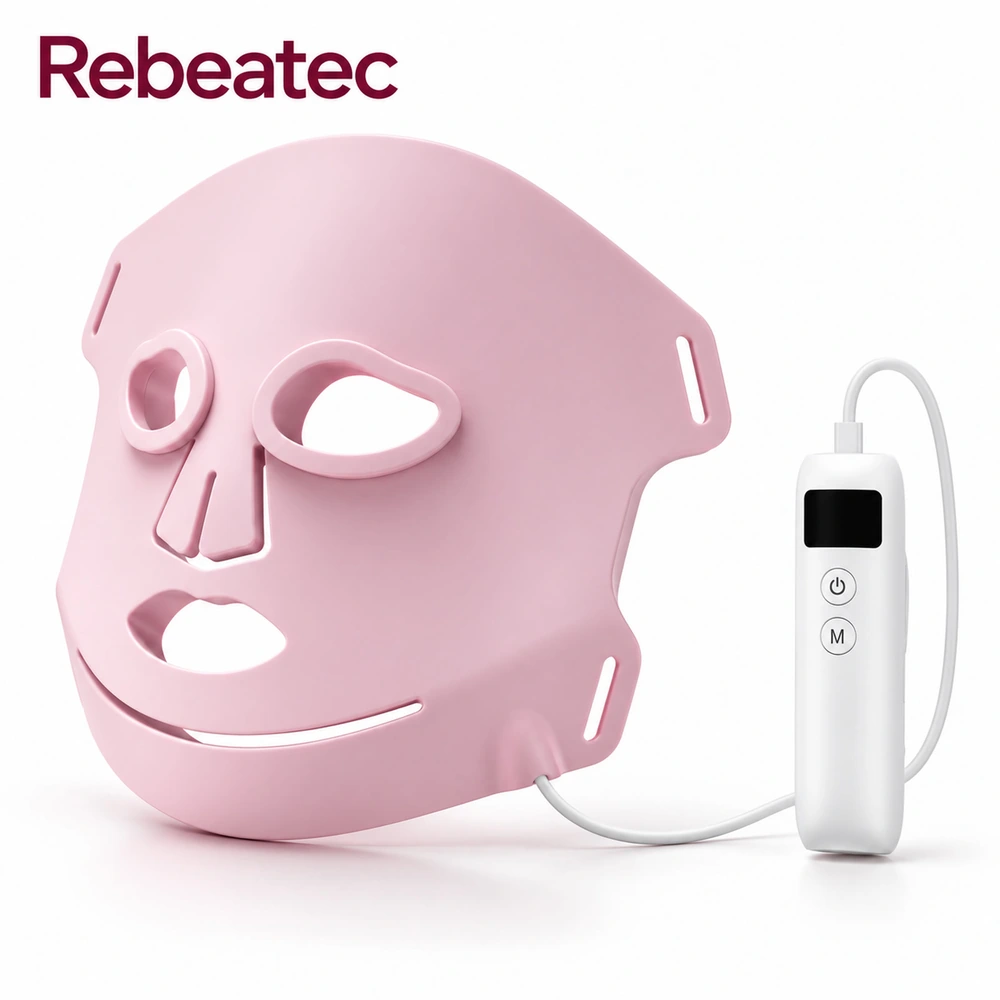
Flexible masks conform to the face, sit closer to the skin, and pack flat — which matters enormously if you sell cross-border or ship to retail shelves. They are typically lighter and feel less clinical, which suits beauty-channel customers. The checks here are build quality of the sealing between the silicone layers, the flex life of the internal wiring, and how evenly the LEDs stay positioned when the mask bends.
Neither format is universally better. The right question is which channel you sell through and what your customer expects the product to feel like in the hand.
Power Delivery: Corded, Battery, or Both
Wireless masks dominate the premium end of the market, and the specification to scrutinize is the battery: capacity in mAh, whether the rated session completes on one charge, charge time, and cycle life. A mask that dies at minute fifteen of a twenty-minute routine will generate returns no matter how good the light output looks on paper.
Corded masks remove battery concerns entirely and lower unit cost, at the price of tethering the customer to an outlet. Hybrid designs — a detachable battery pack or a controller that works both ways — add cost and one more failure point, so ask how the connector is rated for insertions.
- Ask for the battery's cycle-life specification, not just its capacity.
- Ask whether the rated session length was tested from a full charge on a production unit, not a bench sample.
- For corded models, confirm the plug type and safety certification for your target market.
Coverage: Count the Area, Not Just the LEDs
LED count is the number most listings lead with, but density and placement decide performance. Two masks can both claim 300 LEDs while one concentrates them in the cheeks and forehead and the other spreads them evenly across the full face, including the jawline and neck transition. Ask for the LED layout diagram and the coverage area dimension, then compare masks on LEDs per unit area rather than raw counts. For how wavelength and irradiance figures should be read and verified, see the specifications guide linked above — those numbers apply to masks exactly as they do to panels.
Wavelength Configurations in Practice
Face masks most commonly pair red channels around 630–660 nm with near-infrared channels around 830–850 nm; some models add amber or additional channels. What matters for sourcing is less the marketing around each color and more the documentation: every channel should have its peak wavelength stated, and the supplier should be able to tie those numbers to per-unit optical testing. A mask that lets the customer switch between wavelength modes should have each mode documented separately, because mode switching changes the irradiance delivered per session.
Comfort and Safety Details That Drive Reviews
Small design decisions show up directly in your review score, so put them on the checklist:
- Eye area — check for recessed or shielded eye cutouts and ask whether eye protection is included or optional.
- Thermal behavior — the mask should stay comfortable across a full rated session; ask for surface temperature data from continuous-run testing.
- Strap and weight — a heavy rigid mask needs a strap system that holds position without pressure points.
- Cleaning — silicone wipes down; rigid shells with texture trap residue. Match the material to how your customer will actually maintain it.
- Controller — session timer, intensity levels, and mode memory should be operable without reading a manual.
Documentation to Collect per Model
Compliance documentation is confirmed per model and per configuration, not per factory, so collect the document set for the exact SKU you plan to stock. At minimum, ask which of the following are available for your target market: FDA-listed status where applicable, CE documentation, RoHS, and the test reports behind the optical claims. A supplier who can produce serialized per-unit test records — not just batch summaries — is telling you their QA process is real. Our own quality process, from ISO 13485 scope through burn-in testing, is described in our article on how red light devices are tested before shipping.
OEM Customization Options Worth Asking About
If you are building a private label line, mask customization usually extends beyond a logo. Common options include LED count and layout changes, silicone color and finish, controller branding, packaging design, and bundled accessories. Ask early which options affect certification status, because a modified configuration can require updated documentation — it is far cheaper to design the SKU correctly than to retrofit compliance after the fact.
A Mask-Specific Sourcing Checklist
- Rigid or silicone — decided by channel and customer expectation, not by trend
- Battery cycle life and real session runtime on a production unit
- LED layout diagram and coverage area dimensions, not raw LED count
- Peak wavelength documented per channel and per mode
- Eye protection, thermal data, strap fit, and controller usability
- Compliance documents confirmed for the exact SKU and market
- Customization options mapped against certification impact
Compare Two Finished Examples
Seeing how these decisions land in a finished product makes the checklist concrete. The RXpre521 silicone LED facial care mask shows the flexible-format path: full-face conforming fit, wireless operation, and a documented wavelength configuration. The RXpre420 face and neck mask set extends coverage past the jawline, which is worth studying if neck extension is a selling point in your market.
Want the full spec sheet, LED layout diagram, and available certificates for either model? Message us with DM SPEC and the model you are evaluating, and we will send the complete documentation package.