Red Light LED Masks: 4 Key Specs Explained
When comparing red light LED masks, it is easy to focus on the number of LEDs. But LED count alone cannot tell you how much light reaches the intended surface or how evenly it is distributed.
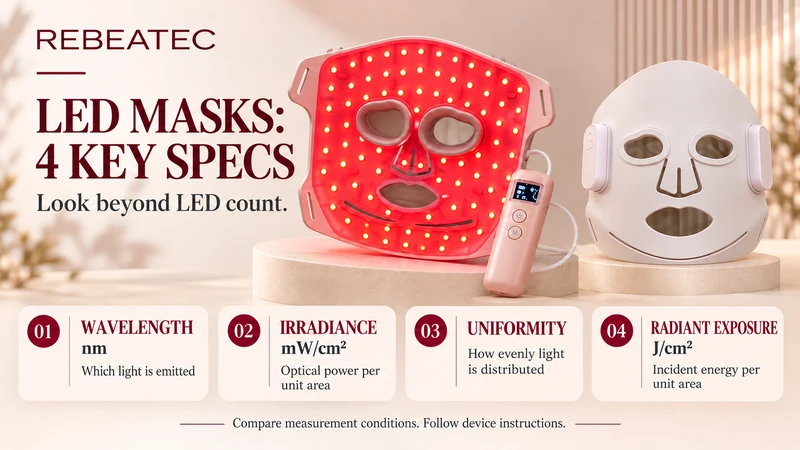
A more useful comparison considers four specifications together: wavelength, irradiance, light uniformity, and radiant exposure. Here is what each means—and what to ask when reading a product specification sheet.
1. Wavelength: Which Light Does the Device Emit?
Wavelength is measured in nanometers, abbreviated as nm. It identifies the spectral region of the light.
For example, 630 nm and 660 nm are visible red wavelengths, while 850 nm is near-infrared. Near-infrared output should not be judged by visible brightness.
A wavelength label is a technical specification, not a guarantee of a particular skincare result.
What to ask: Which wavelengths are available in each operating mode? Are the listed values nominal LED specifications or measured output?
2. Irradiance: How Much Optical Power Reaches a Surface?
Irradiance is optical power per unit area, usually expressed in mW/cm².
The measurement position matters. Ask where the reading was taken, at what distance, and in which operating mode. A single maximum reading should not be mistaken for an average across the face.
Electrical input power is also different from optical irradiance. A device’s wattage cannot be used by itself to calculate mW/cm² at the skin.
What to ask: Is the reported value a peak or an average? What area, distance, instrument, and mode were used for the measurement?
3. Light Uniformity: How Evenly Is the Area Illuminated?
Uniformity describes variation in light output across the intended area.
For an LED face mask, a useful evaluation considers multiple positions rather than one central reading. LED placement, mask shape, and the distance between the light source and the measurement surface are relevant to the comparison.
A photograph of a brightly glowing mask is not a substitute for a measured light-distribution map.
What to ask: Are readings available across several facial positions? Does the report explain the test setup and show both stronger and weaker areas?
4. Radiant Exposure: How Do Output and Time Combine?
Radiant exposure is energy incident on a surface per unit area, commonly expressed in J/cm². It is often called “light dose” in device discussions.
For constant irradiance:
Radiant exposure (J/cm²) = Irradiance (mW/cm²) × Time (seconds) ÷ 1,000
For illustration, a constant irradiance of 20 mW/cm² over 300 seconds gives:
20 × 300 ÷ 1,000 = 6 J/cm²
This is a calculation example, not a recommended setting or a specification for a Rebeatec product.
The calculated value does not tell you how much energy is absorbed within the skin. For pulsed output, the calculation must account for the time-averaged irradiance rather than simply using peak output.
What to ask: Does the stated radiant exposure match the reported irradiance, operating mode, and session duration?
Why LED Count Still Needs Context
LED count describes one part of a device’s construction. It does not replace measurements of optical output.
Also check what the supplier is counting: LED packages, individual emitting chips, or emitters of a particular wavelength. A multi-chip LED package can make headline counts difficult to compare.
For a clearer purchasing decision, request a consistent specification sheet and supporting measurement information.
Frequently Asked Questions
Is a higher LED count always better?
The count alone is insufficient to rank devices. Compare the optical specifications, coverage information, fit, and instructions together.
Can I compare two irradiance numbers directly?
First check whether they were measured under comparable conditions. Different distances, modes, or reporting methods can make the numbers misleading.
Should I extend a session to increase the light dose?
Follow the instructions for your device. The calculation explains energy delivery; it does not establish an appropriate personal-use schedule.
Questions for Brands and Wholesale Buyers
Before selecting an LED face mask for your range, ask your supplier for:
- Wavelength information for each mode.
- Irradiance values with measurement conditions.
- Light-distribution measurements across the intended area.
- Session settings and any pulse parameters.
- A clear explanation of how LEDs are counted.
- Model-specific operating and care instructions.
When discussing a Rebeatec product, identify the exact model and request the information available for that configuration. Specifications from another mask should not be assumed to apply.
A useful comparison starts with clearly defined measurements—not one headline number.
This article explains technical specifications for general educational purposes. It does not establish clinical effectiveness or replace the instructions supplied with your device.