Red Light Therapy Blanket Buying Guide: What Decides Coverage
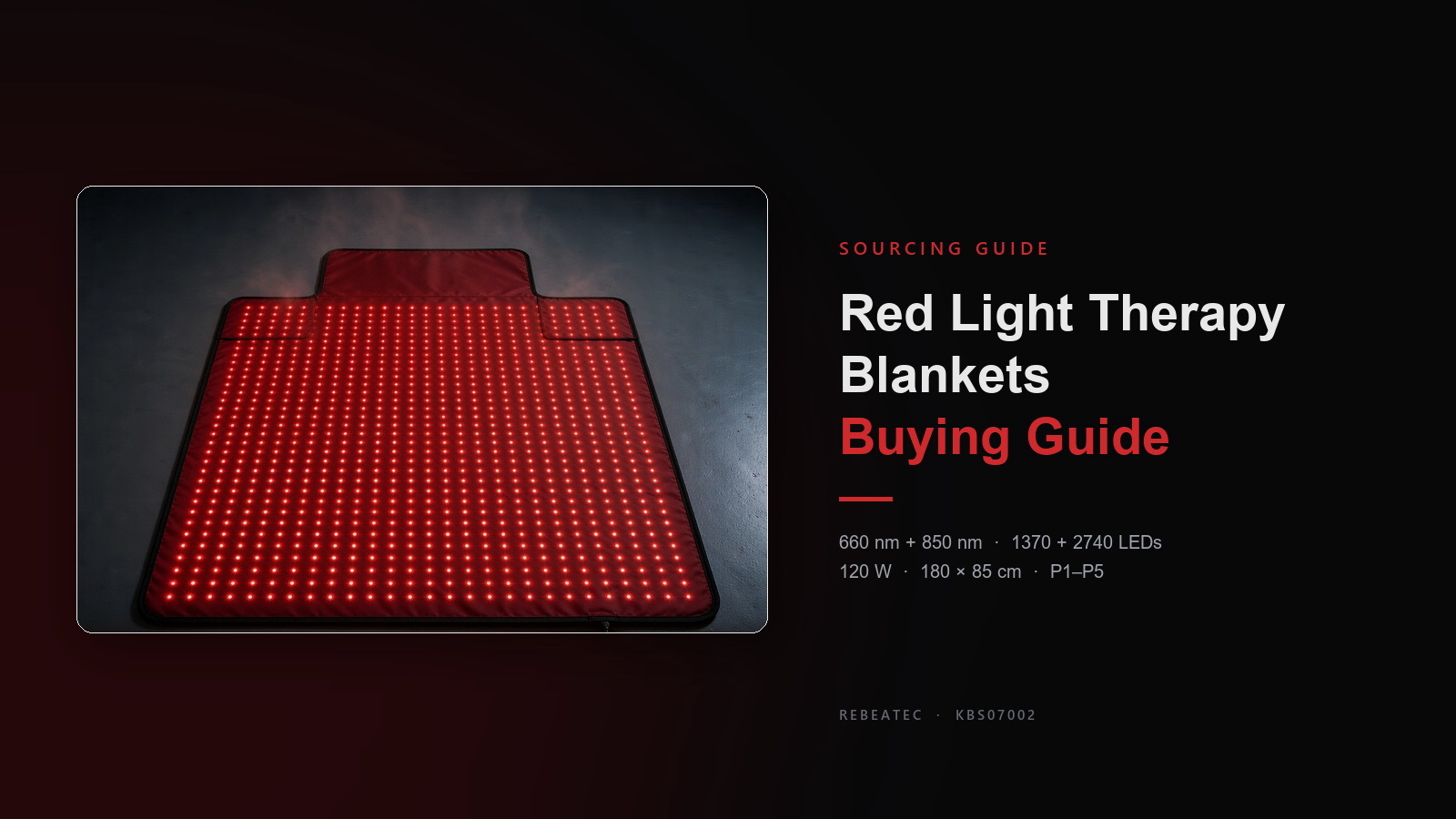
Body-area red light devices are usually searched as three separate things: panels, wraps and blankets. Blankets sit at the far end of that list because they cover the most surface at once, and that is exactly where specification quality becomes hardest to judge from a sales page. This guide walks through the numbers that change what a blanket actually delivers, and the build details that decide whether it survives daily use in a home or a clinic.
Blanket, Mat or Wrap: What the Format Decides
A wrap is built around a joint. It is small, it is strapped on, and it only has to cover a knee, a shoulder or a waist. A blanket has to cover a torso and both legs at once, which means far more LEDs, a larger flexible panel and a distribution problem: intensity at the centre of the body is not the same as at the edges.
That difference is why "full body" has to be measured rather than assumed. Two blankets can both be sold as full body and cover very different areas.
If the open question is blanket against panel rather than blanket against mat, that comparison is separate: putting the two formats on the same coverage scale is where to start.
The Four Numbers That Decide Performance
1. Wavelength pair: 660 nm and 850 nm
Almost every serious blanket runs two wavelengths. 660 nm sits in the visible red band and is absorbed close to the skin surface. 850 nm is near-infrared, invisible to the eye, and reaches deeper tissue. A device that runs only one of the two is covering only part of the picture.
What to check is not that both numbers appear on the page, but the split: how many LEDs run at each wavelength. Our KBS07002 uses 1,370 LEDs at 660 nm and 2,740 at 850 nm, a 1:2 ratio with the infrared side carrying the larger half of the array.
2. LED count and how it is distributed
LED count is the easiest number to print and the least meaningful on its own. What matters is density across the usable area. 1,370 emitters spread over 180 × 85 cm works out at roughly nine per 100 cm²; the same count packed into a 120 × 60 cm mat would be more than twice as dense, and would feel like a different product.
Ask for the pitch, the distance between LEDs, and for the array drawing. If a supplier cannot show you the layout, the count is a marketing figure.
Uniformity is the other half of the same question. A blanket with bright bands at the seams and dim patches between them will feel inconsistent across a session. Edge-to-edge treatment is a build decision, and no LED datasheet tells you whether it was made.
3. Total power and the levels you actually use
120 W is the total draw of the KBS07002 array, spread across five power levels (P1–P5). Wattage on its own does not tell you what reaches the skin: irradiance, measured in mW/cm² at the surface, does. Wattage is the input, irradiance is the output, and the two are only loosely related across different builds.
The practical point for a buyer is level control. A blanket that only runs at full power is either too strong for a long session or too weak for a short one. Five levels let a user step down without cutting the session short.
4. Time and pulse settings
KBS07002 offers nine timer steps between 10 and 90 minutes, plus 10 Hz and 40 Hz pulse modes alongside continuous output. For sourcing, the question is how the timer behaves in use: does it cut power at zero, does it remember the last setting, and is the controller readable at a glance in a dim room?
Size and Fit: 180 × 85 cm, Measured Not Assumed
The KBS07002 measures 180 × 85 cm (71 × 33.4 in). That is long enough to run from the shoulders past the feet and wide enough to fold over the torso, which is the point of the format: the LEDs face the body rather than a wall.
Two things are worth confirming before you commit to a dimension. First, who it is for: a 180 cm blanket is a full-body device for most users and a torso-and-thigh device for very tall ones. Second, how it stores. A blanket this size does not fold into a drawer, and buyers notice that after delivery rather than before.
Build Details Buyers Forget
Surface material and waterproofing come first. The KBS07002 uses a waterproof TPU facing, which matters for two reasons: cleaning between users, and sweat during longer sessions.
Then the seams. A blanket flexes every time it is folded, so the LED strip joints and the cable entry are where failures start. Ask how the cable entry is strain-relieved, and whether the controller connector locks.
Finally the accessories, because a blanket without them is not usable: controller, power adapter, power cord and protective goggles ship with the unit. Confirm the plug type for your market and whether the manual is in the destination language. Both are cheap to fix at order time and expensive to fix afterwards.
Reference Configuration: KBS07002
- Wavelengths: 660 nm red + 850 nm near-infrared
- LED count: 1,370 at 660 nm, 2,740 at 850 nm
- Power: 120 W total, five levels (P1–P5)
- Session: nine steps, 10–90 minutes
- Pulse: 10 Hz and 40 Hz
- Size: 180 × 85 cm (71 × 33.4 in)
- Material: waterproof TPU facing
- In the box: controller, adapter, power cord, goggles
What to Verify in the Paperwork
Certificates are where otherwise careful buyers get caught. The check that matters is simple: the applicant or manufacturer named on each certificate has to be the factory you are actually buying from. A folder of valid certificates issued to five different companies is not evidence about your supplier, however official the scans look.
Ask for the test reports behind the certificate, and read the model number on the report. If it does not match the model you are ordering, the report does not cover your device.
A Short Checklist Before You Order
- Wavelength pair confirmed, with the LED count for each wavelength.
- Array drawing or pitch provided, not just a total count.
- Irradiance figure in mW/cm², and the distance it was measured at.
- Power levels listed, including the lowest usable setting.
- Timer range, step size and shut-off behaviour.
- Measured size in both cm and inches, plus storage dimensions.
- Certificate applicant name matches the manufacturer.
- Plug type, manual language and packaging confirmed in writing.
OEM and Private Label Options
For brands and distributors the blanket format is straightforward to customise: outer fabric colour, logo placement on the panel and on the controller, packaging, manual, plug type and label language. Wavelength mix and size can be adjusted as well, but those change tooling and minimum order quantity, so they are worth settling before artwork begins.
Next Step
You can see the full range on the red light therapy blankets and mats page, or the KBS07002 full body blanket in detail. If you are sourcing for a specific market, send the specification you need through the contact form and we will confirm what is feasible on the line.