
Blanket vs Panel: Which Covers More Body Per Session
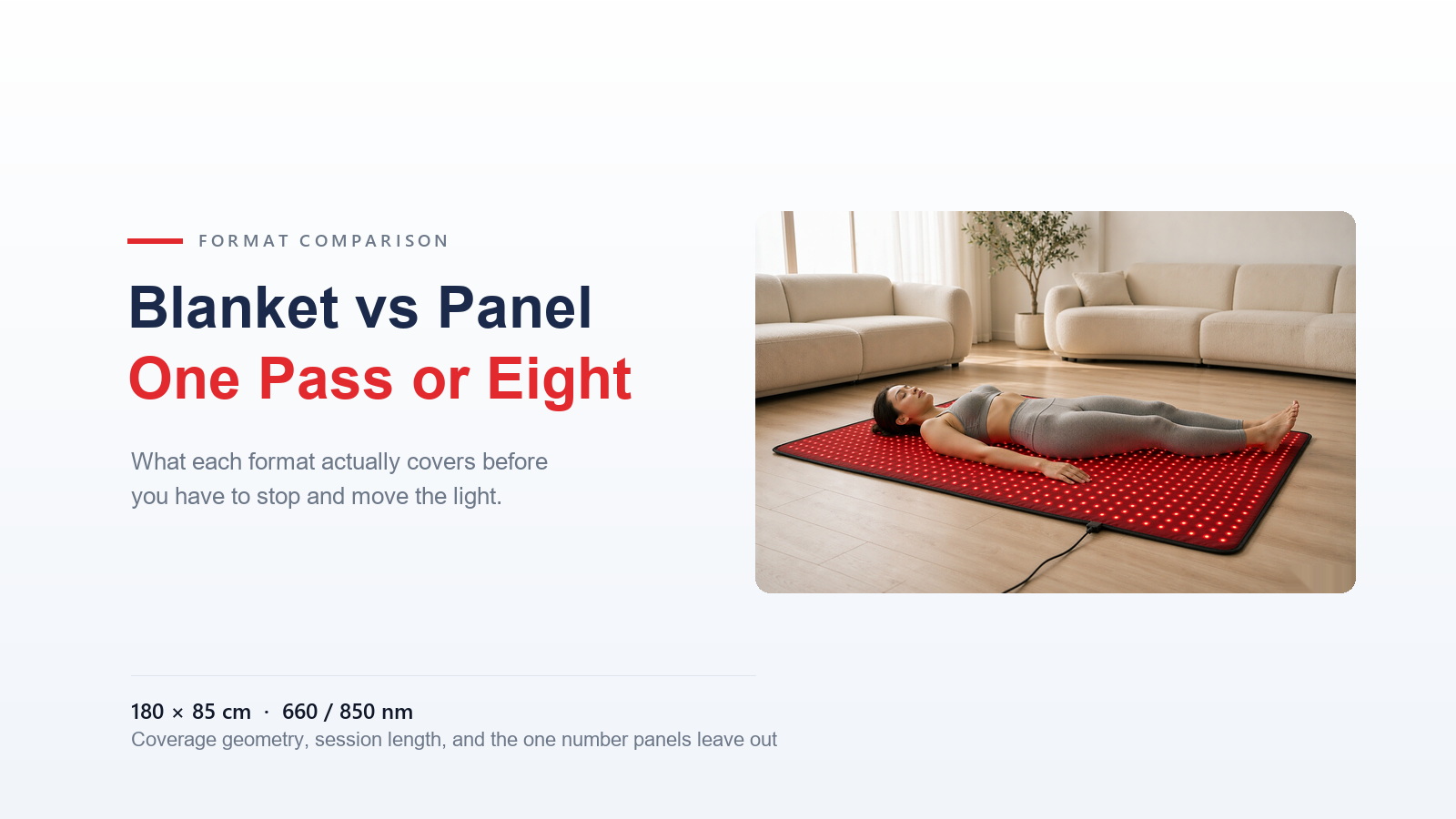
Ask which is stronger — a red light panel or a red light blanket — and the answer is almost always the panel. Ask how much of you is actually under the light during a session, and the answer flips. That second question is the one that decides how long you spend, how consistently you use the thing, and therefore what you get out of it.
This page compares the two formats on coverage first, then on the numbers that coverage controls. If you have already settled on a blanket and want to read a spec sheet properly, the blanket buying guide goes deeper on density, seam build and controls.
The Comparison Usually Starts in the Wrong Place
Panel listings lead with irradiance: 100 mW/cm², 150 mW/cm², sometimes more. Those figures are real, but they are measured at a stated distance — 15 cm is common — at the centre of the panel. A blanket's emitters sit a few millimetres above the fabric, so its quoted figure describes a completely different geometry. Putting the two numbers side by side without the distance attached is like comparing the fuel economy of two cars measured at different speeds.
Dose is what matters: irradiance at the skin, multiplied by time, spread over the area you meant to treat. A panel can win the first term, a blanket wins the third, and the second term — time — is where your routine lives.
Two Geometries, One Decision
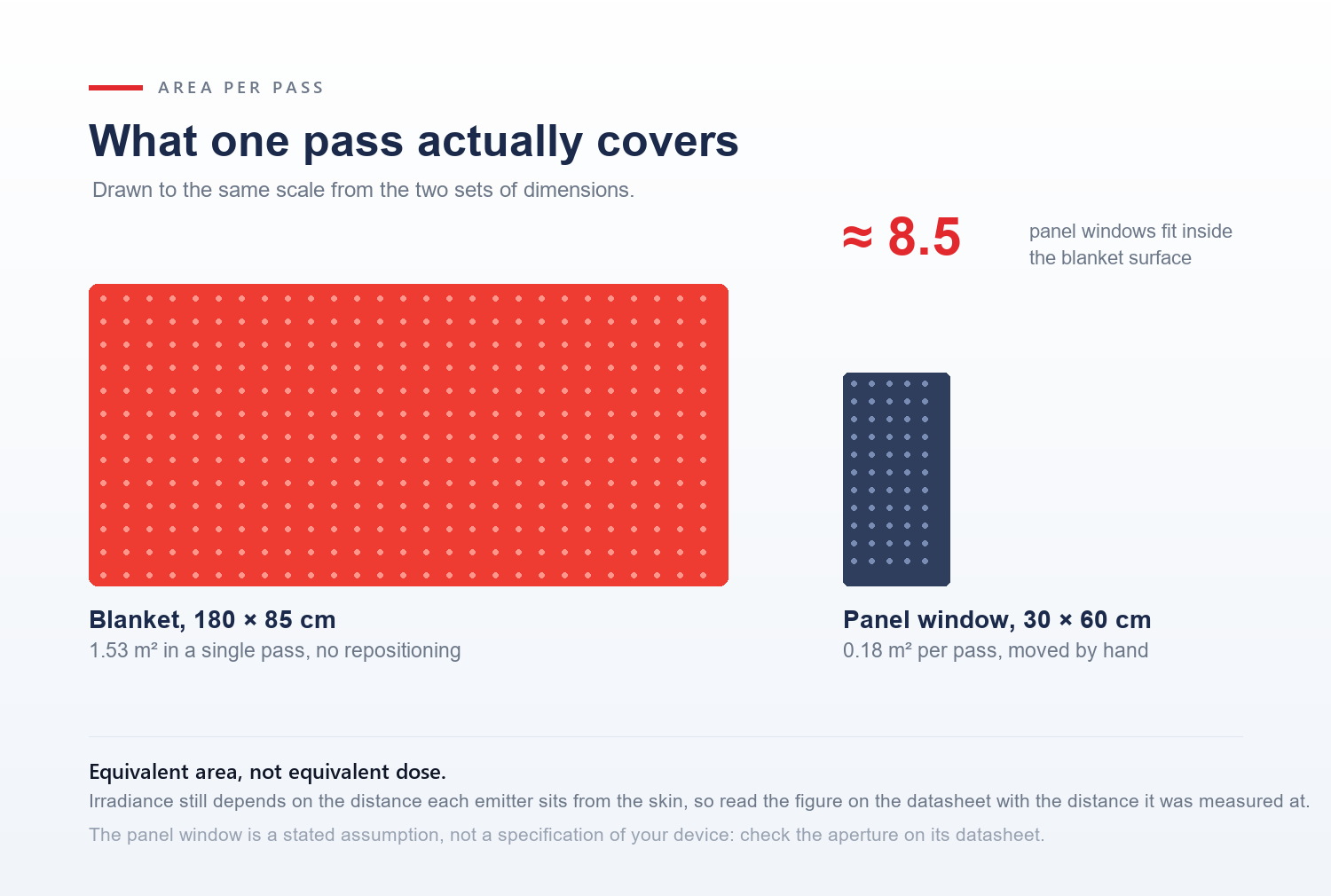
A panel is a flat aperture. You stand or sit in front of it, present one zone, then turn, step, or drag the panel to present the next. A blanket is a surface you get inside: our full-body model measures 180 × 85 cm, with flaps at the shoulders, so an adult lying on it is covered from the back of the head to the heels in one position.
Put the two footprints on the same scale and the difference stops being abstract.
Distance Does the Quiet Work
Irradiance drops steeply as you move away from a panel. That is not a flaw, it is optics, but it has a practical consequence: the useful treatment window in front of a panel is short, and small changes in posture move you in and out of it. Leaning back ten centimetres, slouching, or holding a book changes the dose you actually receive. Panels are usually sold with a stand for exactly this reason, and the stand is part of the device's accuracy.
A blanket removes that variable by construction. The emitter-to-skin distance is set by the fabric and the way you lie on it, so it stays constant for forty minutes and stays the same next Tuesday. The trade-off is a lower peak: the light is spread across a large surface instead of concentrated on one spot. For a whole-body session that is the right trade. For a single knee, it is not.
Session Length: One Pass or Six
This is where the geometry turns into time. A panel session is a sequence — front, back, one side, the other, thighs, calves — and each step has its own clock. A blanket session is one exposure that you can spend lying down.
| Panel | Blanket | |
|---|---|---|
| Coverage per pass | One window, typically a torso-sized area | 1.53 m² on the 180 × 85 cm model |
| Distance to skin | Set by you and the stand; drifts with posture | Fixed by the fabric |
| Session pattern | Several zones, repositioning between them | One exposure, one position |
| Typical session | 10–15 minutes per zone, several zones | 20–30 minutes, whole posterior or anterior chain |
| Strongest case | A single joint, shoulder, or the face | Full-body recovery and wind-down routines |
| Watch for | Standing the whole time; dose varying with posture | Lower peak irradiance; you have to lie down |
Where a Panel Is the Better Tool
If your target is one area — a shoulder that complains after swimming, a knee, the face — a panel concentrates light where you want it and gets the session over with in ten minutes. It also suits households where two people use it in sequence, and it is easier to aim at a specific angle. Nothing about a blanket beats a panel on a single small target.
The cost is attention. A panel session is an activity: you stand, you turn, you keep your distance, you keep your eyes closed. That is fine for ten minutes and tedious for forty, which is why panel owners tend to treat fewer zones than they planned.
Where a Blanket Wins
A blanket wins on the days you would otherwise skip. You lie down, set a timer, and the whole posterior chain is under the light at once: no turning, no counting zones, no standing. For recovery routines that are supposed to happen four or five evenings a week, the format that survives a tired Tuesday is the one that gets used.
Three practical advantages follow from the geometry. Eye protection is included rather than improvised, because your face is inside the field. The session is passive, so it stacks with reading, stretching, or falling asleep. And the coverage scale travels: the same surface is built in canine and equine sizes, which is not something a panel does well.
What to Check Before You Buy Either
- Irradiance with its distance. A figure without a measurement distance is decoration. Ask for the distance and, if possible, the measurement method.
- Aperture or surface area. Multiply the dimensions. It tells you how many passes a session really takes.
- Emitter count against density. A thousand diodes spread over two square metres can be sparser than four hundred over a face-sized shell. Count is marketing; density is physics.
- Wavelength bins and tolerance. 660 nm and 850 nm are the common pair; ask what tolerance the bin allows and write it into the order.
- Timer and pulse settings. A timer that shuts off on its own is the difference between a 20 minute session and a 50 minute one.
- Eye protection. Near-infrared is invisible: the lamp looking dim tells you nothing about what is reaching your retina.
If you are still weighing formats rather than brands, our guide to choosing a red light therapy device covers wavelength, irradiance and coverage in the abstract; the specifications guide explains how to read the numbers once you have them.
The Short Version
Choose a panel if you are treating one area and want maximum intensity there, and you will reliably stand in front of it. Choose a blanket if the goal is whole-body exposure, you want it to happen while you are lying down, and you would rather trade peak intensity for a session you will actually complete. Our full-body blanket is the format described here: 180 × 85 cm, 660 nm and 850 nm, 120 W across the surface, five levels and a timer that runs to ninety minutes.
One caveat that applies to both formats: this is a general comparison, not medical advice. If you take photosensitising medication, are pregnant, or are treating a diagnosed condition, talk to a clinician before adding either device to a routine.