
XPRE448 vs XPRE322 vs XPRE458: Three Silicone LED Masks Compared
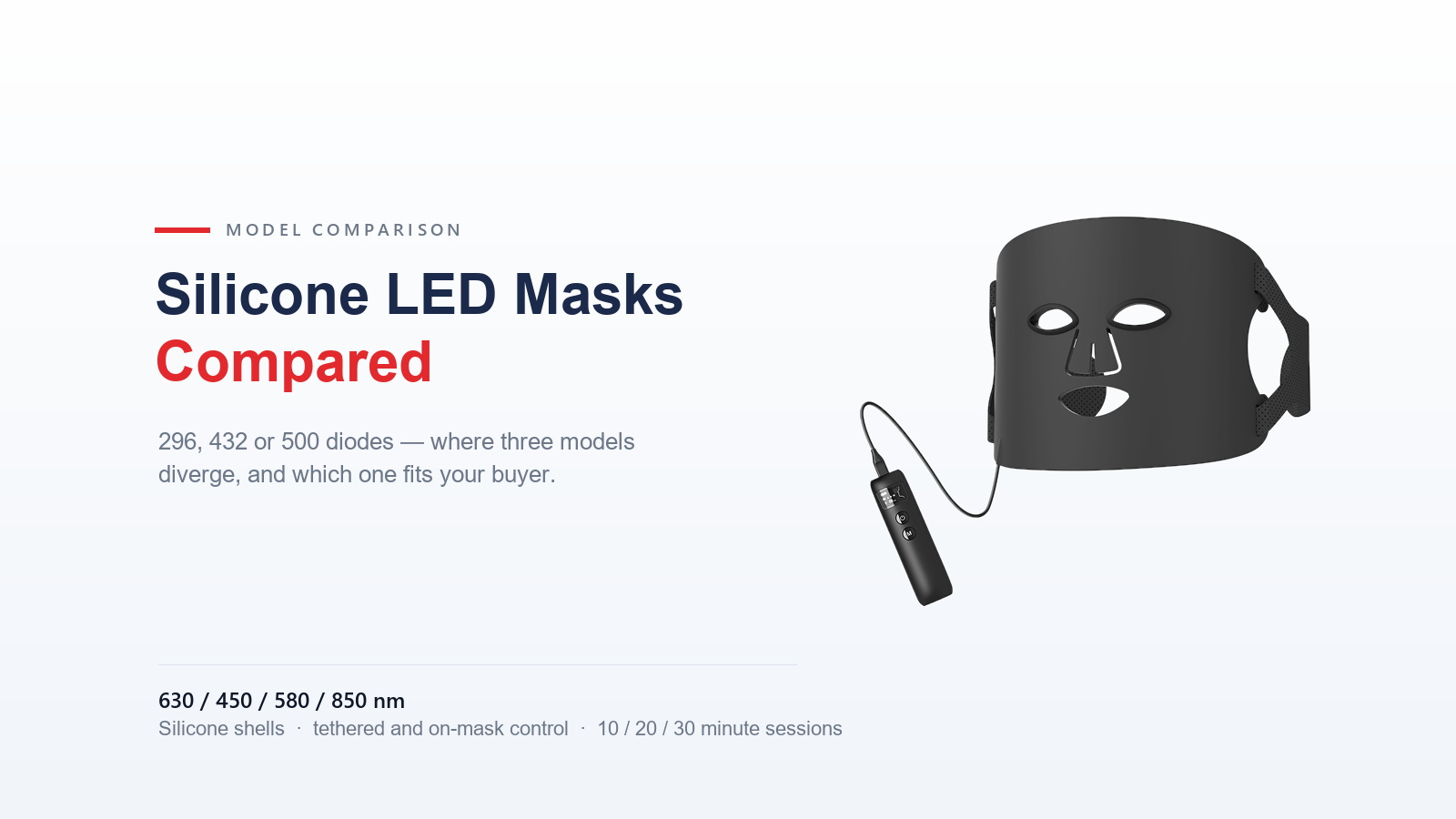
Three masks in the Rebeatec range share one architecture: a moulded silicone shell, four wavelengths, five light modes and an open eye window. Put the datasheets side by side and the decision comes down to three things a buyer has to live with for the life of the order — how many diodes are on the shell, who sets the session, and what the paperwork can actually prove.
This page is about choosing between the three models. If the format itself is still open, start with the LED face mask buying guide; if you need to read an irradiance or uniformity figure properly, the LED mask specifications guide covers that ground in more depth.
The Number on the Box: 296, 432 or 500
All three masks are built from four-in-one packages: a single LED package carrying red, blue, yellow and near-infrared dies. That is why a small package count becomes a large diode count, and why the two numbers on a datasheet differ by a factor of four.
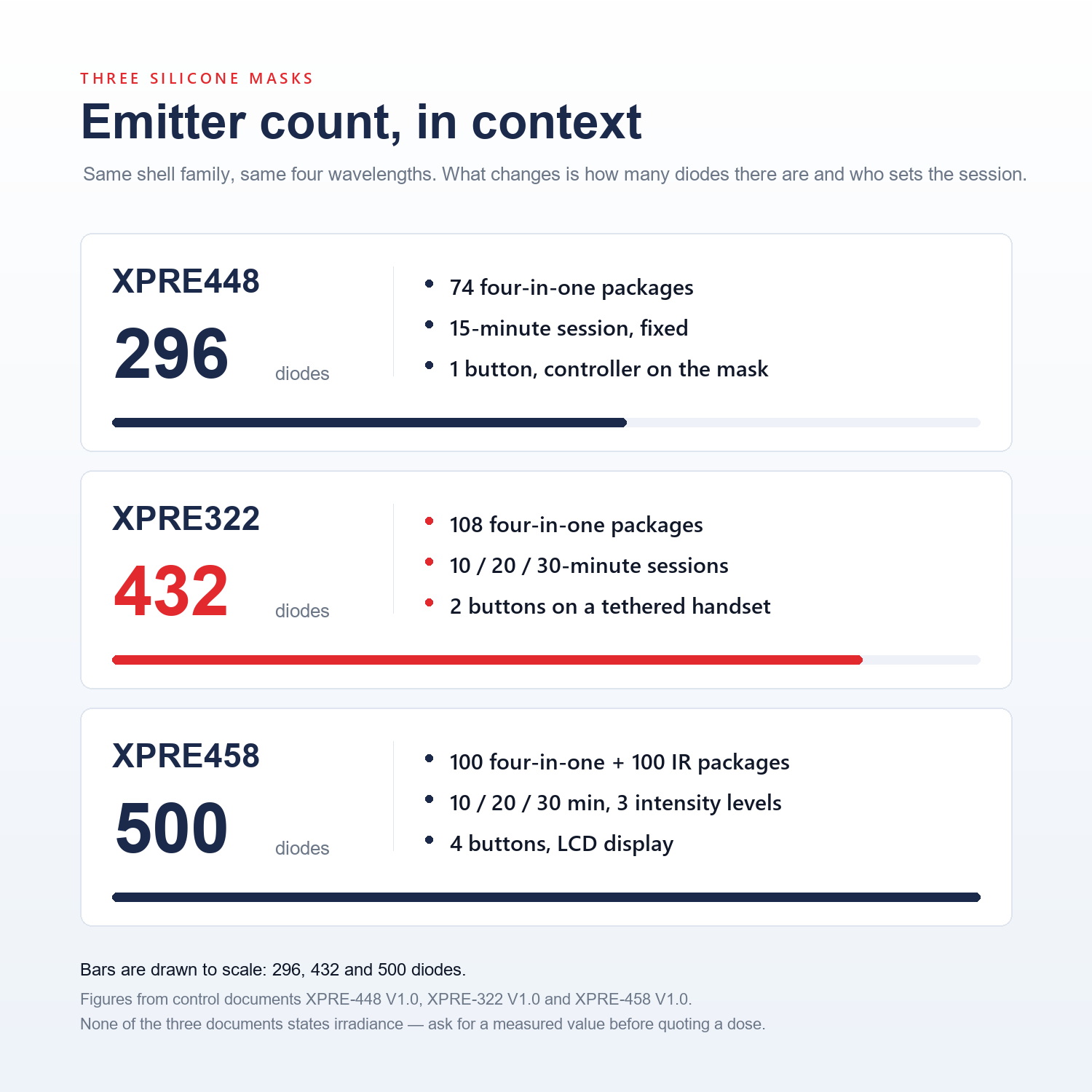
- XPRE448 — 74 packages, 296 diodes
- XPRE322 — 108 packages, 432 diodes
- XPRE458 — 100 four-in-one packages plus 100 dedicated 850 nm packages, 500 diodes
The XPRE458 is the odd one out for a reason: its near-infrared diodes sit in their own packages rather than sharing a four-in-one footprint with the visible colours. That is where the extra emitters go, and it is the one structural difference in the group that is not simply a bigger number.
What 136 Extra Diodes Do and Do Not Buy
Going from 296 to 432 diodes spreads the same work across more dies. Each package runs at a lower drive current for a given output, which means less heat per package and, in practice, a longer service life and less thermal drift during a session. More packages also mean the grid can be laid out at a tighter pitch, so the gaps between illuminated areas get smaller.
What the count does not buy is dose. Irradiance at the skin depends on drive current, optic angle and distance from the surface, not on how many diodes you can count. A 500-diode mask with a hot centre and a dim jaw delivers a worse treatment than a 432-diode mask on an even grid. The useful question is never "how many", it is "where are they, and how evenly does the light land".
That is also why the three models differ so little in wavelength: 630 nm red, 580 nm yellow and 850 nm near-infrared are common to all of them, and the fourth channel is blue — 450 nm on the XPRE322 document, 460 nm on the XPRE448 and XPRE458 documents. A 10 nm shift is small, but it should not be left to chance. Fix the bin and the tolerance in the purchase order rather than assuming the next production run matches the sample.
The Real Fork: Who Sets the Session
This is where a buyer should spend their attention, because it decides who the product suits. The shell is the same; the control surface is not.
| XPRE448 | XPRE322 | XPRE458 | |
|---|---|---|---|
| Diodes | 296 | 432 | 500 |
| Controls | 1 button on the mask | 2 buttons on a handset | 4 buttons on a handset |
| Session | 15 minutes, fixed | 10 / 20 / 30 minutes | 10 / 20 / 30 minutes |
| Intensity | not adjustable | not adjustable | 3 levels |
| Display | none | charge state | LCD, mode and time |
| Battery | 1200 mAh, on the mask | in the handset | 1800 mAh, in the handset |
| Shell | white silicone | black, painted and printed | white silicone |
The XPRE448 is the retail answer. One button, one fifteen-minute cycle, nothing to configure and nothing to lose. There is no separate unit to misplace and no setting a customer can get wrong, which is exactly what a gift-box product needs. The trade-off is that a clinic cannot dial anything down.
The XPRE322 is the value middle. Moving the cell and the keys into a handset takes weight off the face and adds a session choice — 10, 20 or 30 minutes — without adding an energy setting. It is the model to quote when the buyer wants more emitters than the entry SKU but will not pay for a screen, and its black shell reads as a different product on a shelf next to the two white ones.
The XPRE458 is the clinic answer. Four keys, an LCD, three intensity levels and the largest emitter count in the group. When a treatment protocol has to escalate over a course, or when the operator wants to read remaining time without lifting the mask, this is the only one of the three that allows it.
Shell, Colour and the Details That Come Back in Reviews
Two of the three are white silicone; the XPRE322 is black, painted and silk-screened. Colour is not only cosmetic. A white shell shows foundation and residue and needs wiping after every session; a black shell hides it but shows fingerprints and scuffs. Buyers running a hygiene-heavy protocol tend to prefer the shell that shows the dirt, because staff can see what needs cleaning.
All three keep the eye window open rather than moulded shut, so a wearer can read or watch something during a session. All three are built to GB 4706.1 and GB/T 36419-2018. And all three run the same five modes — red, blue, yellow, near-infrared, red plus blue — stepped through in that order.
What None of the Three Datasheets Says
None of the three control documents states an irradiance figure in mW/cm². That is worth saying plainly rather than filling the gap with a number: irradiance without a measurement distance is not comparable between suppliers, and radiant exposure — the figure that actually corresponds to a protocol — is irradiance multiplied by time.
The only model in the range with a published figure is the XPRE441 acne patch at 40 mW/cm², and even there the document does not state the distance at which it was measured. If a customer needs a dose figure, ask us for the measurement report; we would rather send a measured value than an estimated one.
Three questions close this gap in any quotation:
- What is the irradiance at the treatment surface, in mW/cm²?
- At what distance from the LEDs was it measured?
- What meter and what aperture were used?
Which One to Specify
- Retail, gift and subscription boxes — XPRE448. Fewest ways for an end user to get it wrong.
- Mid-tier private label, or a second SKU beside a white mask — XPRE322. Handset control, more emitters, a visually distinct black shell.
- Clinics, salons and protocol-driven resellers — XPRE458. Intensity levels and a readable display.
- Whole-face treatment with a single spot concern — neither. That is a patch, and the XPRE441 is built for it.
OEM and Private Label
All three are built to order with shell colour, logo, packaging and manual language. Because the electronics are shared, a buyer can take the XPRE322 platform and specify a white shell, or take the XPRE448 and add a session selector, without a new tooling cycle — the difference between the models is the control board and the emitter layout, not the mould.
Tell us the market, the channel and whether the device will be operated by a consumer or a practitioner. The model usually follows from those three answers, and we will quote the emitters and the sessions that fit rather than the largest number on the list.
Next Step
Full specifications, images and downloadable detail for each model:
- XPRE448 — wireless 3D silicone mask, 296 diodes
- XPRE322 — silicone mask with handset control, 432 diodes
- XPRE458 — silicone mask with LCD controller, 500 diodes
For body-area devices the same logic applies at a larger scale; the blanket buying guide walks through coverage, LED density and power levels for wraps and mats.